

Saltwater Intrusion: Causes, Impacts and Solutions
Saltwater Intrusion: Causes, Impacts and Solutions


Along California's coast, as with 77% of all coasts globally, the groundwater that farms and cities depend on sits right next to the Ocean. When we pump that groundwater faster than nature can refill it, the ocean moves in. This process is called saltwater intrusion, or seawater intrusion. Once it reaches a well, that well can become too salty to use for drinking or irrigation.
This post explains what saltwater intrusion is, what causes it, where it is happening in California, and how communities are fighting back. It also looks at how new water supplies, including subsea desalination, can take pressure off overpumped coastal aquifers and even recharge some of those aquifers directly.
What is saltwater intrusion?
Saltwater intrusion is the movement of ocean water into freshwater aquifers. Under natural conditions, fresh groundwater flows toward the sea and holds the saltwater back near the coastline. When pumping reduces that seaward flow, seawater is pulled inland and into the freshwater zone.
What causes saltwater intrusion?
The main cause of saltwater intrusion in California is groundwater overpumping. Researchers have long linked intrusion in the state's coastal aquifers mainly to groundwater overdraft, especially in Southern California. Drought makes it worse, because less rain means less natural recharge to push back against the ocean.
Sea level rise adds a second, slower pressure. A higher ocean raises the boundary between salty and fresh groundwater and lifts coastal water tables. A USGS-led study found that models ignoring local topography substantially underestimate saltwater intrusion along the California coast.
How does groundwater pumping cause it?
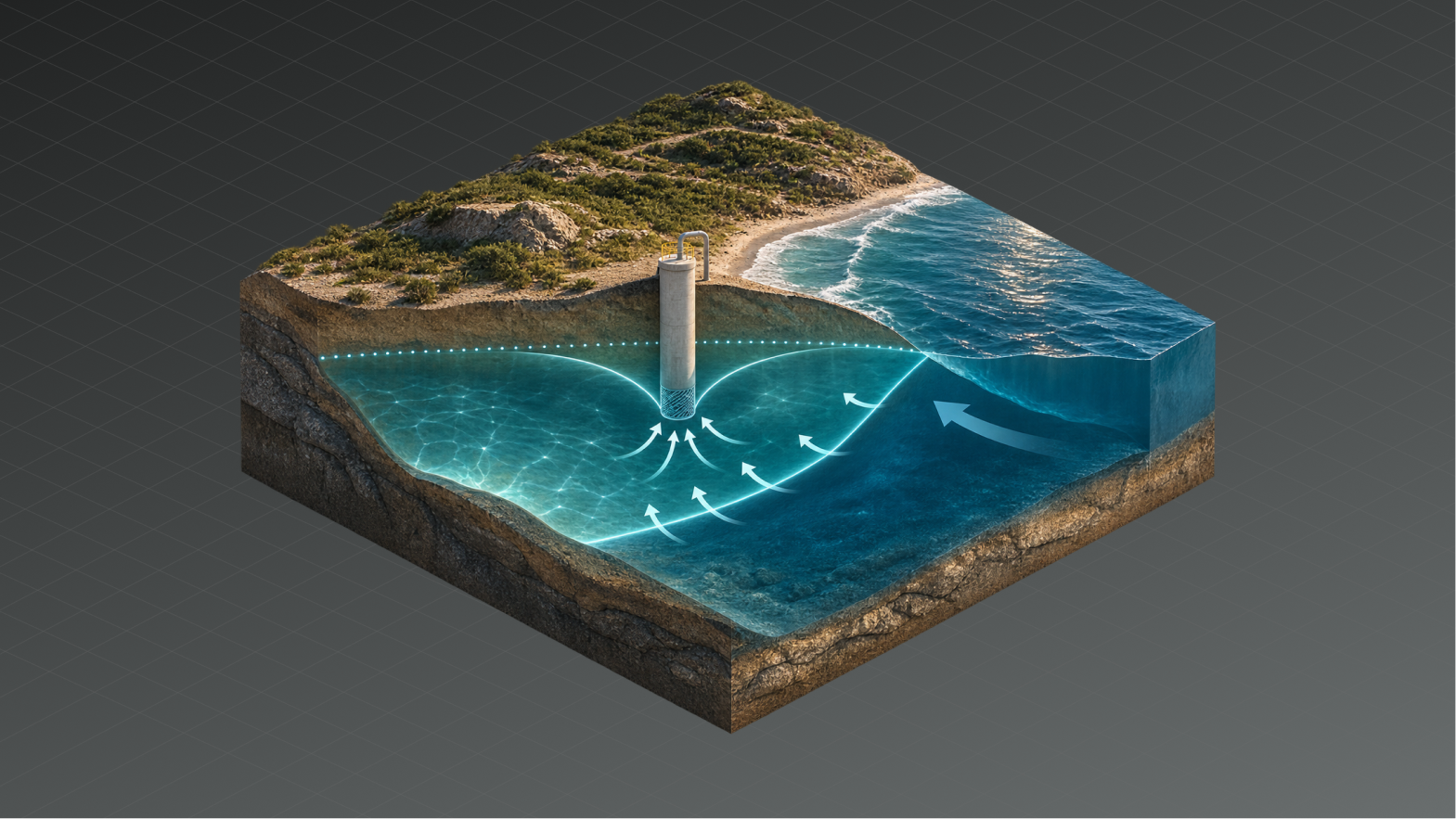
Pumping lowers groundwater levels near the coast and reduces the volume of fresh water flowing toward the sea. Once that seaward push weakens, saltwater is drawn toward the freshwater parts of the aquifer. In the worst cases, inland water levels fall below sea level and the ocean flows in freely.
Intrusion happens in two main ways. In lateral intrusion, a wedge-shaped body of denser seawater, called the saltwater wedge, creeps inland along the bottom of the aquifer. In upconing, saltwater rises from deeper in an aquifer toward a pumping well, drawn upward by the well's suction. Leaky or abandoned wells can also act as pipes that let saltwater move between aquifers.
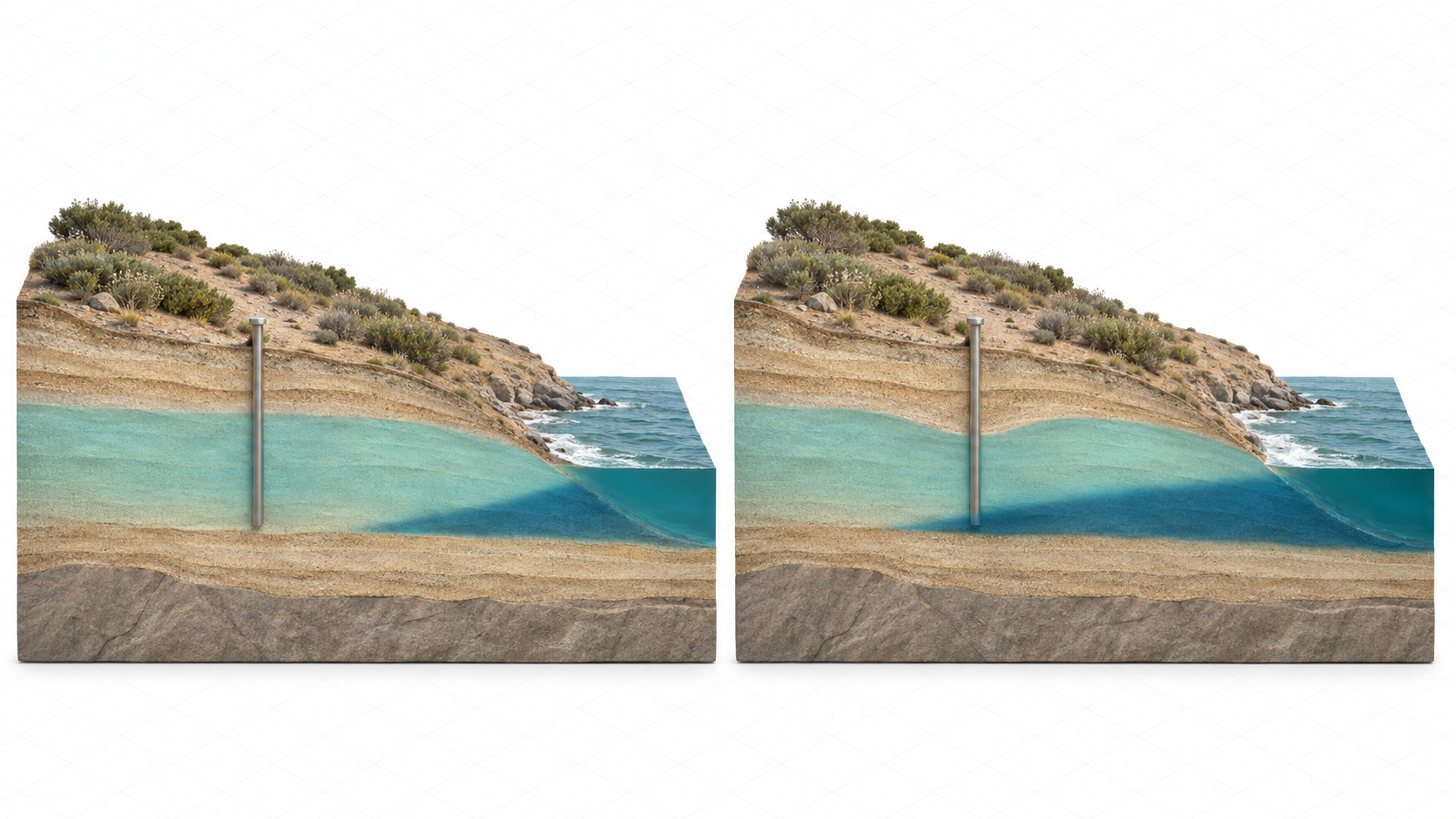
Left: a coastal aquifer before overpumping. Right: sustained pumping lowers the water table and draws saltwater toward the well. Illustration by OceanWell, based on the U.S. Geological Survey.
Case Study: How far has seawater intruded in the Salinas Valley?
In the Salinas Valley, seawater has pushed more than five miles inland since intrusion began in the 1930s. It is the clearest example of seawater intrusion in California. The valley's main aquifers are named for their depths. Monterey County's water agency measured intrusion about 6 miles inland in the 180-Foot Aquifer and about 3 miles in the 400-Foot Aquifer along the valley floor. The problem is still growing. In 2022, land above intruded water in the 400-Foot Aquifer grew by 365 acres in a single year. Much of that growth came from "islands" of salty water that likely leaked downward from the shallower aquifers.
County hydrologists have said the intrusion probably cannot be reversed, and the realistic goal is to stop it from spreading. Monterey County publishes updated intrusion maps on its seawater intrusion monitoring page.
Salinas is not alone. Coastal Los Angeles County faced the same crisis in the mid-1900s, and the Santa Cruz Mid-County Basin lists seawater intrusion as one of its two key groundwater concerns (Santa Cruz Mid-County GSP).
How does saltwater intrusion affect communities?
Saltwater intrusion shrinks the amount of usable fresh water stored underground, and in severe cases forces communities to abandon supply wells (USGS). Once an aquifer is contaminated, the damage can be irreversible, leaving agencies to choose between losing the well or paying for costly treatment (Santa Cruz Mid-County GSP).
- Agriculture: Salty irrigation water harms crops and soil. In the Salinas Valley, many wells in the 180-Foot Aquifer have already been taken offline, shifting pumping to deeper aquifers.
- Drinking water: Coastal cities lose a local, low-cost supply and must buy more imported water.
- Infrastructure and health: Rising coastal groundwater can push water toward buried pipes, septic systems and contaminated soil, a risk researchers are now studying in Southern California (Long Beach Post).
What is a seawater intrusion barrier?
A seawater intrusion barrier is a line of injection wells along the coast that pumps fresh water underground. Positioned like an underground dam, the wells keep water levels near the ocean high enough to hold seawater out of the aquifer (West Basin MWD).
Los Angeles County pioneered this approach. The West Coast Basin Barrier Project grew from a 1953 experiment at Manhattan Beach (LA County Public Works). Today, three barriers (West Coast Basin, Dominguez Gap and Alamitos Gap) inject an average of about 28,000 acre-feet a year of imported and advanced-treated recycled water (ITRC case study). West Basin began supplying highly treated recycled water to the West Coast Basin barrier in 1995.
How is saltwater intrusion managed or stopped?
No single fix works everywhere. Most coastal basins use a mix of tools:
- Reduce groundwater pumping near the coast so water levels can recover. This is the most direct fix, and the hardest for communities that depend on wells.
- Managed aquifer recharge adds water back underground through spreading basins or injection wells, using stormwater, river water, recycled water or, soon, from sustainably desalinated water produced by a subsea RO system.
- Seawater intrusion barriers build a wall of fresh water pressure between the ocean and the aquifer.
- Monitoring and limits on new wells. Monterey County samples about 120 wells for intrusion each year, and hydrologists there have recommended a moratorium on new wells in affected parts of the 400-Foot Aquifer (Monterey County Weekly).
- New, drought-proof water supplies such as recycled water and desalination, which let communities pump less groundwater in the first place.
How does SGMA address seawater intrusion in California?
California's Sustainable Groundwater Management Act (SGMA) makes seawater intrusion one of six sustainability indicators that local agencies must manage (Santa Cruz Mid-County GSP). Under SGMA, groundwater sustainability agencies set measurable limits and must avoid significant and unreasonable intrusion. In the Salinas Valley, the plan's goal is to halt intrusion at its 2017 line of advance (LandWatch comment letter).
Can desalination help reduce saltwater intrusion?
Yes. Desalination gives coastal communities a reliable water supply that does not depend on rainfall or groundwater. Every gallon a community gets from the ocean is a gallon it does not have to pump from a stressed coastal aquifer, which helps water levels recover and keeps seawater offshore.
Desalination as an alternative water supply can also support the solutions above. Water from new sources can be blended into recharge projects and seawater barriers, the same way recycled water is used today, freeing local groundwater for its natural role as a buffer against the ocean.
The problem with using water from a traditional desalination plant is two-fold: it’s expensive and zero sum. In other words it trades one environmental benefit for an environmental cost to the ocean.
Subsea desalination: a coastal groundwater alternative
OceanWell aims to address both problems posed by traditional desalination plants by reducing the cost per AF of water to an economically viable level, whilst ensuring the ocean remains unharmed by the process.
OceanWell's modular pods sit more than 400 meters (1,300 feet) below the surface, where natural ocean pressure powers the reverse osmosis process (OceanWell via FISHBIO).
Each pod is designed to produce up to one million gallons of fresh water a day, and OceanWell estimates about 40% less energy use than a conventional plant (New Atlas). When OceanWell announced Water Farm 1, CEO Robert Bergstrom named seawater intrusion and overdrawn groundwater among the pressures new supply must withstand (New Atlas). Learn more in our subsea desalination explainer and on the Water Farm 1 page.
The bottom line
Saltwater intrusion is a slow-moving crisis, and once seawater reaches an aquifer it is very hard to remove. Barriers, recharge and smarter pumping limits have kept it in check in places like Los Angeles County, but they all depend on having enough fresh water to work with. As droughts deepen and sea levels rise, California's coastal communities need new, drought-proof supplies that ease the demand on groundwater.
Subsea desalination is one of those supplies.
References
- U.S. Geological Survey. Saltwater Intrusion. https://water.usgs.gov/ogw/gwrp/saltwater/salt.html
- Barlow, P.M., and Reichard, E.G. (2010). Saltwater intrusion in coastal regions of North America. Hydrogeology Journal. https://www.usgs.gov/publications/saltwater-intrusion-coastal-regions-north-america
- Befus, K.M., et al. (2020). Increasing threat of coastal groundwater hazards from sea- level rise in California. Nature Climate Change. https://pubs.usgs.gov/publication/70212542
- Hoover, D.J., et al. (2017). Sea-level rise and coastal groundwater inundation and shoaling at select sites in California, USA. Journal of Hydrology: Regional Studies. https://escholarship.org/uc/item/5mc1q3bp
- Groundwater Exchange. Salinas Valley – 180/400 Foot Aquifer. https://groundwaterexchange.org/?p=4911
- Monterey County Water Resources Agency, via CSU Monterey Bay Digital Commons. Seawater intrusion study. https://digitalcommons.csumb.edu/hornbeck_cgb_6_b/7
- Monterey County Water Resources Agency. Seawater Intrusion Monitoring. https://countyofmonterey.gov/government/government-links/water-resources-agency/programs/seawater-intrusion-monitoring
- Monterey County Weekly (2023). County's latest seawater intrusion maps reveal an intractable problem that's getting worse. https://www.montereycountynow.com/news/local_news/county-s-latest-seawater-intrusion-maps-reveal-an-intractable-problem-that-s-getting-worse/article_53e2a678-b2e0-11ed-83f7-371d5b71afab.html
- Monterey County Weekly (2017). County hydrologists recommend a moratorium on new wells in some areas. https://www.montereycountynow.com/blogs/news_blog/county-hydrologists-recommend-a-moratorium-on-new-wells-in-some-areas/article_3c438224-b29d-11e7-84f2-4764df8118a2.html
- Santa Cruz Mid-County Groundwater Agency. Groundwater Sustainability Plan, Section 1. https://www.midcountygroundwater.org/sites/default/files/uploads/Section_1.pdf
- LandWatch Monterey County (2021). Comments on the 180/400-Foot Aquifer Subbasin GSP. https://landwatch.org/pages/issuesactions/water/060921-LWComments-SVGBGSACrowfoot.pdf
- West Basin Municipal Water District. Seawater Barriers. https://westbasin.org/?p=221
- Los Angeles County Public Works. Seawater Barrier. https://pw.lacounty.gov/core-service-areas/water-resources/seawater-barrier/
- Interstate Technology and Regulatory Council. Managed Aquifer Recharge case study: Southern Los Angeles County seawater barriers. https://mar-1.itrcweb.org/case-studies-3/
- Long Beach Post. Long Beach researchers to study how rising sea levels could pollute fresh groundwater. https://lbpost.com/news/long-beach-researchers-to-study-how-rising-sea-levels-could-pollute-fresh-groundwater
- New Atlas. Subsea desalination plant will turn Pacific Ocean into tap water. https://newatlas.com/environment/subsea-desalination-pacific
- Aquatech. US subsea RO desalination project tackles scarcity. https://www.aquatechtrade.com/news/desalination/subsea-reverse-osmosis-project-us-first-california
- FISHBIO. OceanWell and Las Virgenes Municipal Water District launch California Water Farm 1. https://fishbio.com/news/oceanwell-and-las-virgenes-municipal-water-district-launch-california-water-farm-1-with-capacity-of-60-million-gallons-per-day-as-six-agencies-join-project/

Heading