




Water Scarcity: The Invisible Crisis Shaping Our Future
Water Scarcity: The Invisible Crisis Shaping Our Future


Water scarcity is often imagined as distant dry riverbeds, cracked soil, or faraway regions struggling to survive. But in reality, water scarcity is already shaping our lives in quieter, less visible ways. Long before taps run dry, the ripple effects of limited water availability touch our food systems, public health, energy supply, and economic stability. It is not a future problem. It is a present one.
At its core, water scarcity is about imbalance. Water is a closed loop or in other words, a cycle. 97% of earth’s water is in the ocean, about 1% is drinkable water. At varying times, that balance changes and several factors, including human consumption, has an impact on the cycle.
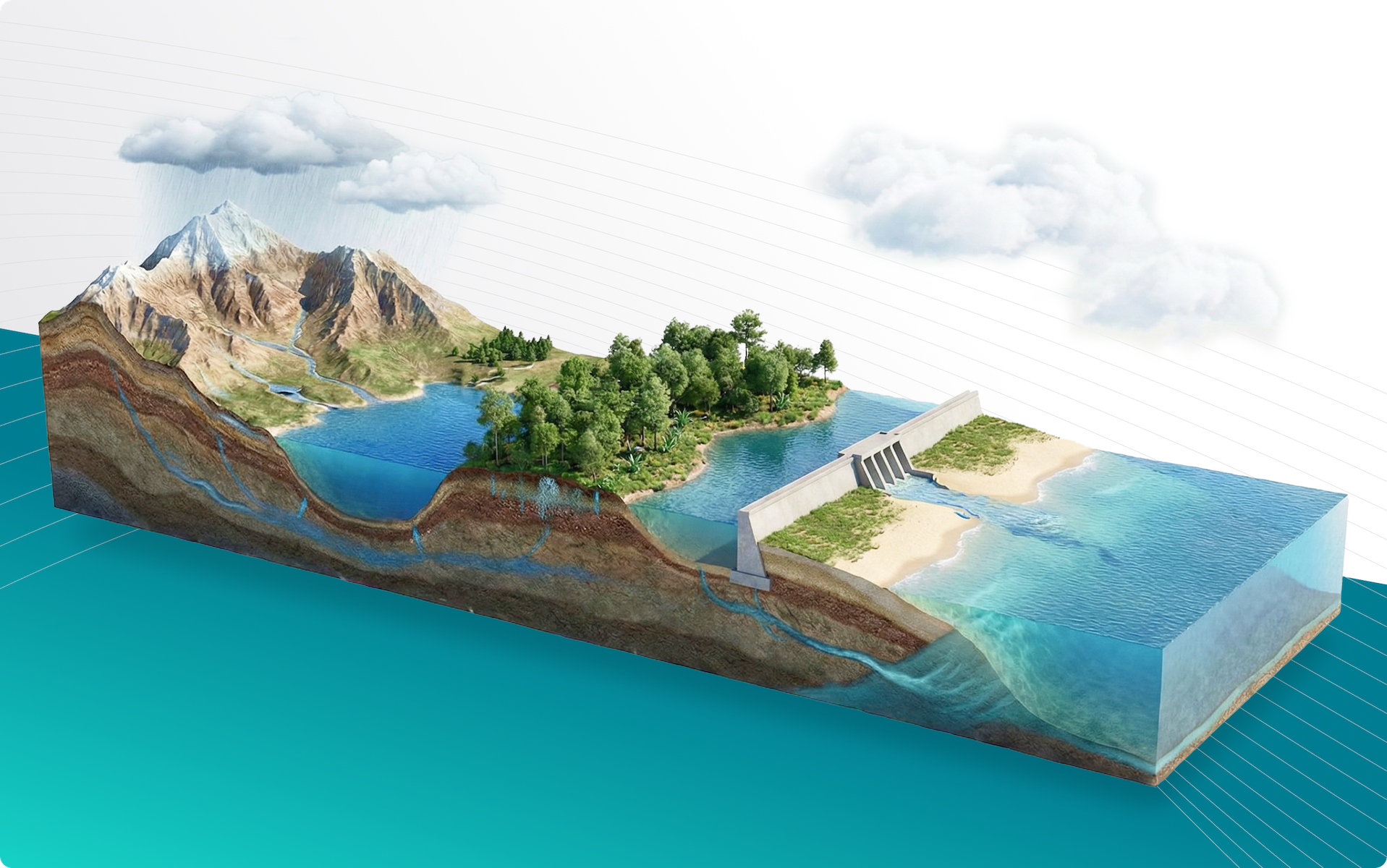
Water is a unique commodity. It’s expensive to move and store relative to it sunderlying value. You also experience evaporative losses in doing so, makingthe on going supply/demand balance even more sensitive.
Sea levels are rising due to melting polar ice caps, meaning fresh water is entering the oceans at a faster rate than the regenerative capabilities of Earth’s freshwater cycle from precipitation and ground water/surface water outflow, with global mean sea level having risen by about 8–9 inches (21–24 cm) since 1880 and currently increasing at nearly 4 mm per year.
The role of Desalination
There is therefore no lack of available water on the planet for us to use, namely in the ocean. It may even accelerate or rebalance the cycle by doing so, but it has to be done responsibly. In some regions that brined is charge has been linked with declines in metrics of biodiversity (e.g., macrobenthic community indices) near discharge outfalls in the Gulf. So, in order to ensure that desalination serves as a net positive to Earth’s water cycle, meaning that land and ocean are working harmoniously, it has to be done with ocean health as the first priority. In other words, without the strong brine, the chemicals and the marine life mortality. These are the pillars on which OceanWell was built.
A Water Dependent Economy
When demand for water exceeds available supply or when infrastructure and management fail to deliver clean, reliable water, entire systems begin to strain. Agriculture is often the first to feel the pressure. Crops require consistent water to grow, and when supplies are uncertain, food production declines. This doesn’t just affect farmers; it shows up as higher grocery prices, reduced food quality, and increased reliance on imports.
Water Use Reshaping the Planet
In a striking example of how deeply human activity is reshaping the planet, scientists have found that large-scale groundwater pumping has actually altered the Earth’s tilt. A 2023 study published in Geophysical Research Letters found that between 1993and 2010, the over extraction of groundwater redistributed so much mass that it shifted Earth’s rotational pole by approximately 80 centimeters (about 2.6 feet). Researchers estimate that humans pumped roughly 2,150 gigatons of groundwater during that period much of which eventually flowed into the oceans, contributing to sea-level rise.
This finding underscores a powerful reality: water scarcity is not just a local or regional issue—it is a planetary one. Our collective overuse of groundwater is significant enough to measurably influence the physical balance of the Earth’s seasonality.
Reduced Energy Reliability
Our energy systems are closely tied to water as well. Hydropower depends on flowing rivers and full reservoirs, while many power plants require large volumes of water for cooling. As water becomes less predictable, energy reliability is diminished. In a world increasingly dependent on stable power, water scarcity quietly threatens the backbone of modern life.
The Indirect Consequence to Our Health
What’s more, we’re seeing that aridification also brings an increase in air pollution. Globally, more than 50% of the world’s large lakes and reservoirs have experienced significant declines in water storage since the early 1990s, largely due to climate change and human water use. A 2022 study found that nearly one-quarter of the global population lives in endorheic (closed-basin) regions, where shrinking lakes can expose toxic lakebeds. For example, dust from the dryingSalton Sea in California has been linked to elevated particulate matter (PM10) levels, contributing to some of the highest childhood asthma hospitalization rates in the state. Similarly, the shrinking Aral Sea has exposed more than 60,000 square kilometers of former lakebed, creating toxic dust storms that carry salt and agricultural chemicals hundreds of miles. These examples illustrate that aridification does not just reduce water availability, it can directly intensify air pollution and public health risks.
Reliable access to clean water is essential for sanitation, hygiene, and disease prevention. When water systems are stressed, communities face higher risks of contamination and illness. These impacts disproportionately affect vulnerable populations, including low-income communities, children, and the elderly deepening existing inequalities and placing additional strain on healthcare systems.
The Illusion of Abundance
One of the most dangerous aspects of water scarcity is how easy it is to ignore. In many regions, water still flows from the tap, creating the perspective that, like air, we have an infinite amount of it. Aging infrastructure, population growth, and shifting climate patterns, however, are steadily eroding that reliability. Leaks, inefficiencies, and outdated systems waste vast amounts of water every day, even as demand continues to rise.
Water scarcity isn’t an abstract future threat; its impacts are already measurable and affect billions of people worldwide. Globally, roughly half of the world’s population experiences severe water scarcity for at least part of the year, and about 4 billion people and nearly two-thirds of humanity face severe water scarcity during at least one month annually.
Beyond sheer availability, access is a massive issue: over 2 billion people live in countries where water supplies are inadequate, and many more lack safe,reliable drinking water close to their homes. What’s more, renewable freshwater available per person has declined by about 7 percent over the past decade as demand rises and climate pressures intensify.
A $58 Trillion Problem
Putting it all together, water scarcity directly threatens food production, livelihoods, and the global economy. AWWF report in partnership with financial experts highlights that water and freshwater ecosystems are worth $58 trillion annually, equivalent to 60% of global GDP.
When water becomes uncertain, everything else follows. Addressing water scarcity is not about fear or alarm, it is about foresight. It requires thoughtful leadership, investment in resilient infrastructure, smarter management, and a collective commitment to valuing water as the finite and essential resource it is.
The choices we make today will determine whether future generations inherit resilient, sustainable systems or fragile ones struggling to keep up.
References
Water Scarcity Facts and Statistics, Britannica
https://www.britannica.com/story/water-scarcity-facts-and-statistics
Water Scarcity, UNICEF https://www.unicef.org/wash/water-scarcity
Statistics | UN World Water Development
Report, UNESCO https://www.unesco.org/reports/wwdr/en/wwdr/en/2024/statistics
Renewable Water Availability Per Person
Plunges, FAO https://www.fao.org/newsroom/detail/renewable-water-availability-per-person-plunges-7-percent-in-a-decade-as-global-scarcity-deepens--fao-data-shows/
Seo, K.-W., Ryu, D., Eom, J., Jeon, T., Kim,J.-S., Youm, K., Chen, J., & Wilson, C. R. (2023). Drift of Earth’s poleconfirms groundwater depletion as a significant contributor to global sea levelrise 1993–2010. Geophysical Research Letters, 50(12), e2023GL103509. https://doi.org/10.1029/2023GL103509
Ibrahim, Hamed D. and Elfatih A. B. Eltahir.“Impact of Brine Discharge from Seawater Desalination Plants on Persian/ArabianGulf Salinity.” Journal of Environmental Engineering, vol. 145, no. 12, 2019, 04019084. EltahirResearch Group, MIT, https://eltahir.mit.edu/journal/impact-of-brine-discharge-from-seawater-desalination-plants-on-persian-arabian-gulf-salinity/
University of California, Riverside. SaltonS ea dust triggers lung inflammation. UC Riverside News. https://news.ucr.edu/articles/2022/12/08/salton-sea-dust-triggers-lung-inflammation?
Food and Agriculture Organization of the United Nations. (2023). Global water usein agriculture statistics (AQUASTAT database). FAO. https://www.fao.org/aquastat
WorldBank. (2016). High and dry: Climate change, water, and the economy.World Bank. https://www.worldbank.org/en/topic/water/publication/high-and-dry-climate-change-water-and-the-economy
Lindsey,R., Lumpkin, R., & Sweet, W. (2023). Climate Change: Global Sea Level.NOAA Climate.gov. Retrieved from https://www.climate.gov/news-features/understanding-climate/climate-change-global-sea-level

Related Posts



Heading


