



Brine Management Innovations: How OceanWell Neutralizes Desalination Waste
Brine Management Innovations: How OceanWell Neutralizes Desalination Waste


Brine Management Innovations: How OceanWell Solves the Brine Problem
For coastal communities facing drought, desalination promises reliable fresh water but brings a difficult environmental challenge along with it: brine. Brine from desalination is the concentrated salty discharge left over after fresh water is harvested . If desalination waste is released without careful planning, it can damage coastal ecosystems, alter salinity balance near the seafloor, and create ecological stress for marine organisms. Thoughtful brine management strategies are necessary for desalination to be ocean safe, particularly at the large scales needed to replace water supplies lost to warming temperatures. Recent innovation in this space is moving quickly and OceanWell is emerging as a leader in designing solutions that neutralize brine and prevent impact to marine life and ocean.
Understanding why brine is harmful and why brine management matters
The byproduct of desalination can be far saltier than natural seawater and when poorly engineered can sink into stagnant pockets near the ocean floor, both disrupting biological processes and reducing oxygen availability. The effects are not just ecological. Managing brine from desalination is an expensive ongoing operational requirements for water plants. Researchers have explored zero liquid discharge, mineral recovery, advanced diffusers, and deepwater outfall systems, yet many options require high energy use or prove impractical at large scale and generally add to the cost of the fresh water produced. This is why new approaches that rethink how brine is produced and where it is released matter.
How OceanWell transforms brine management through deep sea reverse osmosis
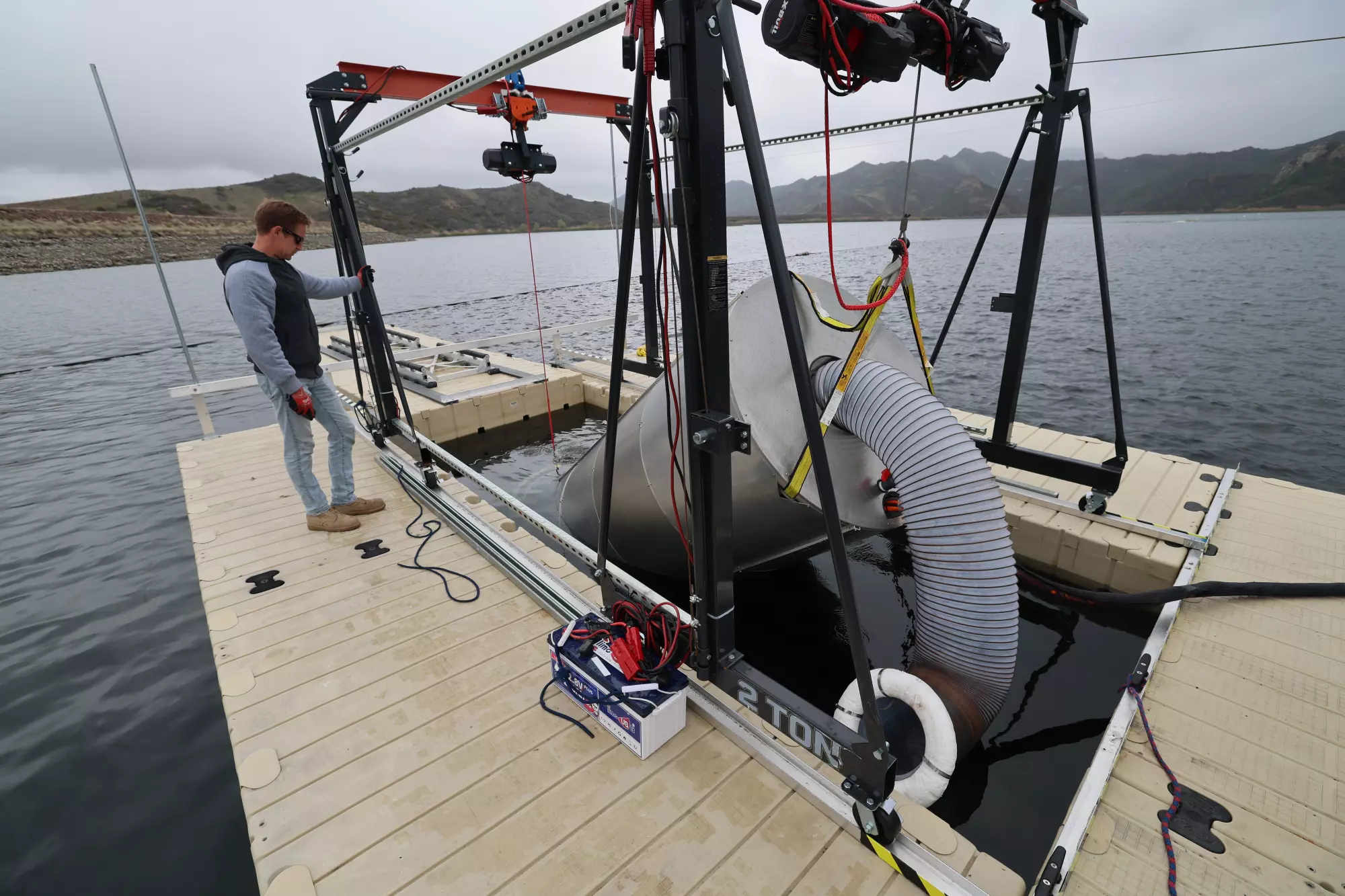
OceanWell approaches brine management differently by moving desalination offshore and taking advantage of natural hydrostatic pressure at depth. The technology places modular desalination units deep in the ocean where natural pressure drives reverse osmosis. This eliminates the energy needed to separate freshwater from seawater. The economic imperative of squeezing the maximum amount of fresh water from the process as the membranes can tolerate disappears. This simple change gives OceanWell the design freedom to harvest a small percentage of water from the seawater moving past the membranes, meaning the remaining seawater (the “brine”) is much less salty than typical desalination brine and naturally diffuses to ambient salinity within a few meters of the point of discharge. Instead of discharging brine directly to fragile nearshore environments, the design releases it in deeper ocean currents where natural mixing can dilute it more effectively. Fresh water rises to shore through a pipeline while the outfall is high above the seafloor where it dissipates naturally without increasing the salinity of the surrounding area over time or being reingested by the system. OceanWell also incorporates intake and discharge designs intended to reduce the risk to marine life and prevent sharp salinity spikes. The aim is simple but important: Produce clean water while allowing the salts to blend back into the ocean without forming dense, harmful plumes.
Comparing this system to conventional brine management methods
Traditional desalination plants manage brine through combing with non-saline wastewater, diffusers, long pipelines, or energy-intensive evaporation systems. Zero liquid discharge nearly eliminates waste but is expensive and power hungry, and mineral extraction is still limited by low concentrations of valuable elements. OceanWell’s deep-sea approach reduces onshore infrastructure, avoids heavy brine-treatment equipment, and places brine where natural dispersion occurs. This approach offers a new brine management model focused on prevention and integration rather than after-the-fact forced diffusion with its energy consumption and shear impacts.
Environmental considerations that deserve long term attention
No solution exists without tradeoffs. Subsea desalination pods reduce nearshore impacts, but maintenance in deep water and potential effects on unfamiliar ecosystems must be monitored. Environmental review, performance data over time, and transparent reporting are essential for responsible brine management. OceanWell and others working in subsea reverse osmosis will need to demonstrate how ecosystems respond not just in the first year but over decades. To ensure that local brine effects are avoided, monitoring programs will track changes in salinity and biodiversity around release points.
Why OceanWell releases brine upward and how quickly it dissipates
Instead of allowing concentrations of higher salinity water to settle on the seafloor where it could create stagnant saline pools, OceanWell releases the byproduct upward in the water column. . This is intentional. Mid-column currents create mixing faster than still water at the bottom, and the salt plume dilutes into surrounding seawater inside a short dispersal window. Because the brine is only mildly concentrated to begin with, salinity differences equalize very rapidly. The upward release is a form of natural dilution that works with water densities and ocean circulation rather than against it.
The economics of pressure and why it matters
Energy use is typically the most expensive part of desalination. Traditional systems must burn energy to pressurize seawater before filtration even begins. OceanWell avoids much of that energy cost because the deep ocean provides the pressure for free. When the pressure input is already present, operating costs drop, many aspects of maintenance become simpler, and the economics shift in favor of sustainability. Lower energy use means every gallon of freshwater costs less to produce, and lower recovery rates mean the outfall exits the system much closer to ambient ocean salinity than land-based plants can afford to achieve. In economic terms, reducing pressure requirements lowers both the cost of harvesting fresh water and the cost of brine management itself.
Conclusion
Brine management is one of the most important challenges facing modern desalination. OceanWell shows that brine does not have to be a heavy cost burden. By using deep ocean pressure to power separation and dispersing low-toxicity salts into natural currents, this approach reduces environmental risk and energy demand at the same time. Since our ultimate goal is a world with abundant freshwater and healthy oceans, thoughtful brine management is one of the keys to defining how we get there.
Sources and further reading
Overview article on subsea desalination pilot projects and energy advantages. Wall Street Journal coverage. https://www.wsj.com/tech/clean-water-deep-sea-desalination-technology-731a1577. The Wall Street Journal
SmartWater Magazine reporting on a U.S. subsea desalination project off Malibu and OceanWell specifics. https://smartwatermagazine.com/news/smart-water-magazine/first-us-subsea-desalination-project-moves-forward-malibu-coast. Smart Water Magazine
Recent scientific review of reject brine disposal and management strategies. MDPI Buildings review. https://www.mdpi.com/2075-5309/15/13/2317




Heading